


Hey there! As a supplier of PVC Profile Production Lines, I've seen firsthand how crucial temperature control is in the whole production process. In this blog, I'm gonna break down the requirements for temperature control in a PVC Profile Production Line.
Why Temperature Control Matters
Before we get into the nitty - gritty of the requirements, let's talk about why temperature control is so important. PVC, or polyvinyl chloride, is a thermoplastic material. That means its properties change significantly with temperature. If the temperature is too high during the production process, the PVC can degrade. This leads to a loss of mechanical properties, like strength and flexibility, and can also cause discoloration and an unpleasant odor. On the other hand, if the temperature is too low, the PVC won't melt or flow properly, resulting in uneven profiles and poor surface finish.
Temperature Requirements at Different Stages
1. Extrusion Process
The extrusion process is the heart of PVC profile production. It involves melting the PVC resin and forcing it through a die to create the desired profile shape.
- Barrel Temperature:
- The barrel of the extruder is where the PVC resin gets heated and melted. Generally, the temperature in the feeding section of the barrel should be relatively low, around 140 - 160°C. This helps to prevent the PVC from melting too early and clogging the feeder. As the resin moves towards the compression and metering sections, the temperature gradually increases. In the compression section, the temperature can range from 160 - 180°C, and in the metering section, it can reach 180 - 200°C. These temperatures ensure that the PVC is fully melted and has a consistent viscosity for smooth extrusion.
- Die Temperature:
- The die is the tool that gives the PVC its final shape. The die temperature needs to be carefully controlled to ensure that the extruded profile maintains its shape and has a good surface finish. Usually, the die temperature is set slightly lower than the metering section of the barrel, around 170 - 190°C. This allows the PVC to start solidifying as it exits the die while still being malleable enough to take the shape of the die accurately.
2. Cooling Process
After the PVC profile is extruded, it needs to be cooled down quickly to solidify and maintain its shape.
- Water Cooling Tanks:
- Water cooling is the most common method used in PVC profile production. The temperature of the water in the cooling tanks is a critical factor. The initial cooling tank usually has a relatively high water temperature, around 30 - 40°C. This helps to prevent the outer layer of the profile from solidifying too quickly, which could cause internal stress and warping. As the profile moves through subsequent cooling tanks, the water temperature gradually decreases. The final cooling tank may have water at around 15 - 20°C to fully solidify the profile.
- Air Cooling:
- In some cases, air cooling is also used in combination with water cooling. The temperature of the air used for cooling should be at room temperature or slightly lower. Air cooling can help to remove any residual heat from the surface of the profile and improve the overall cooling efficiency.
3. Post - Processing and Storage
Even after the profile is fully cooled, temperature control is still important during post - processing and storage.
- Post - Processing:
- If the PVC profiles are going to be further processed, such as cutting, welding, or bending, the temperature of the working environment needs to be controlled. For example, when welding PVC profiles, the welding area needs to be heated to a specific temperature (usually around 200 - 220°C) to ensure a strong bond. The surrounding environment temperature should be kept relatively stable to prevent thermal stress on the profiles during the post - processing operations.
- Storage:
- PVC profiles should be stored in a cool and dry place. The ideal storage temperature is between 10 - 30°C. If the storage temperature is too high, the profiles may start to deform over time. On the other hand, extremely low temperatures can make the profiles brittle and more prone to cracking.
How We Ensure Temperature Control in Our Production Lines
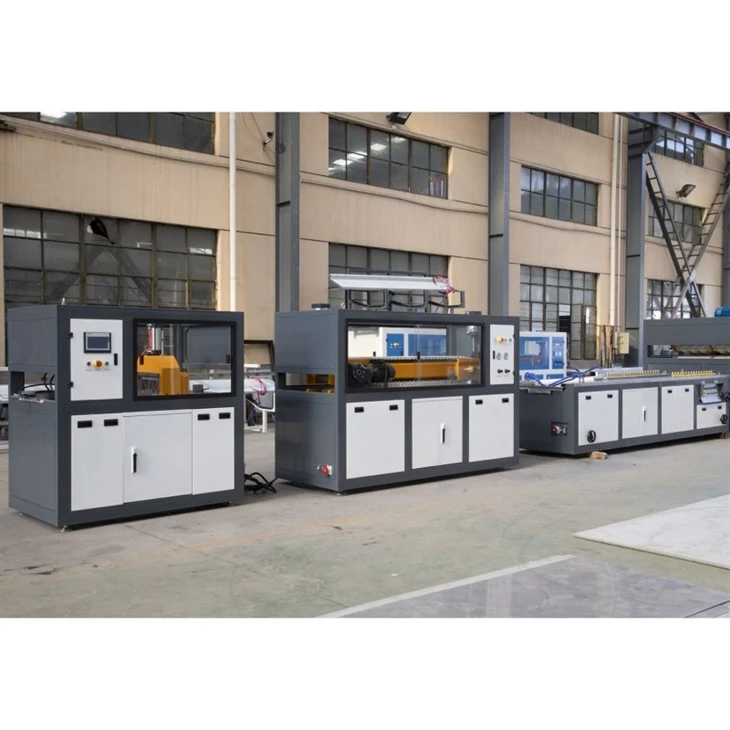
As a PVC Profile Production Line supplier, we take temperature control very seriously. Our production lines are equipped with advanced temperature control systems.

- Heating and Cooling Equipment:
- We use high - quality heaters and coolers in our extruders and cooling tanks. These devices are designed to provide precise temperature control. For example, our extruder barrels are equipped with electric heaters that can be adjusted to maintain the desired temperature at each section. In the cooling tanks, we have temperature sensors and flow control valves to ensure that the water temperature is kept within the required range.
- Automated Control Systems:
- Our production lines are integrated with automated control systems. These systems continuously monitor the temperature at different points in the production process and make real - time adjustments. For instance, if the temperature in the die starts to deviate from the set value, the control system will automatically adjust the heater power to bring the temperature back to the desired level.
Our Product Range
We offer a wide range of PVC Profile Production Lines to meet different customer needs. Check out our PVC Window Profile Extrusion Line, which is designed to produce high - quality PVC window profiles with excellent temperature control during the production process. We also have the PVC WPC Hollow Door Panel Board Extrusion Machine for manufacturing hollow door panels, and the PVC Wall Panel Profile Production Line for producing wall panels.
Conclusion
In conclusion, temperature control is a critical aspect of PVC profile production. From the extrusion process to post - processing and storage, maintaining the right temperature at each stage is essential for producing high - quality PVC profiles. As a reliable PVC Profile Production Line supplier, we are committed to providing production lines that offer precise temperature control and excellent performance.
If you're in the market for a PVC Profile Production Line and want to learn more about how our products can meet your temperature control requirements, don't hesitate to reach out. We're here to help you start or improve your PVC profile production business.
References
- "Plastics Extrusion Technology" by Allan A. Griff
- "PVC Processing Handbook" by G. W. Becker and D. Braun


